Understanding Laser Wavelength: The Key to Choosing the Right Laser for Your Application
In the world of laser marking, engraving, cutting, and cleaning, one fundamental property reigns supreme: laser wavelength. It's not just a technical specification; it's the critical factor determining how a laser interacts with different materials and ultimately dictates the success of your application. Let's demystify this essential concept.
What is Laser Wavelength machine? The Color of Light
Simply put, wavelength is the "color" of the laser light, measured in nanometers (nm) or micrometers (µm - also called microns, μ). It defines the specific type of electromagnetic radiation the laser produces.
-
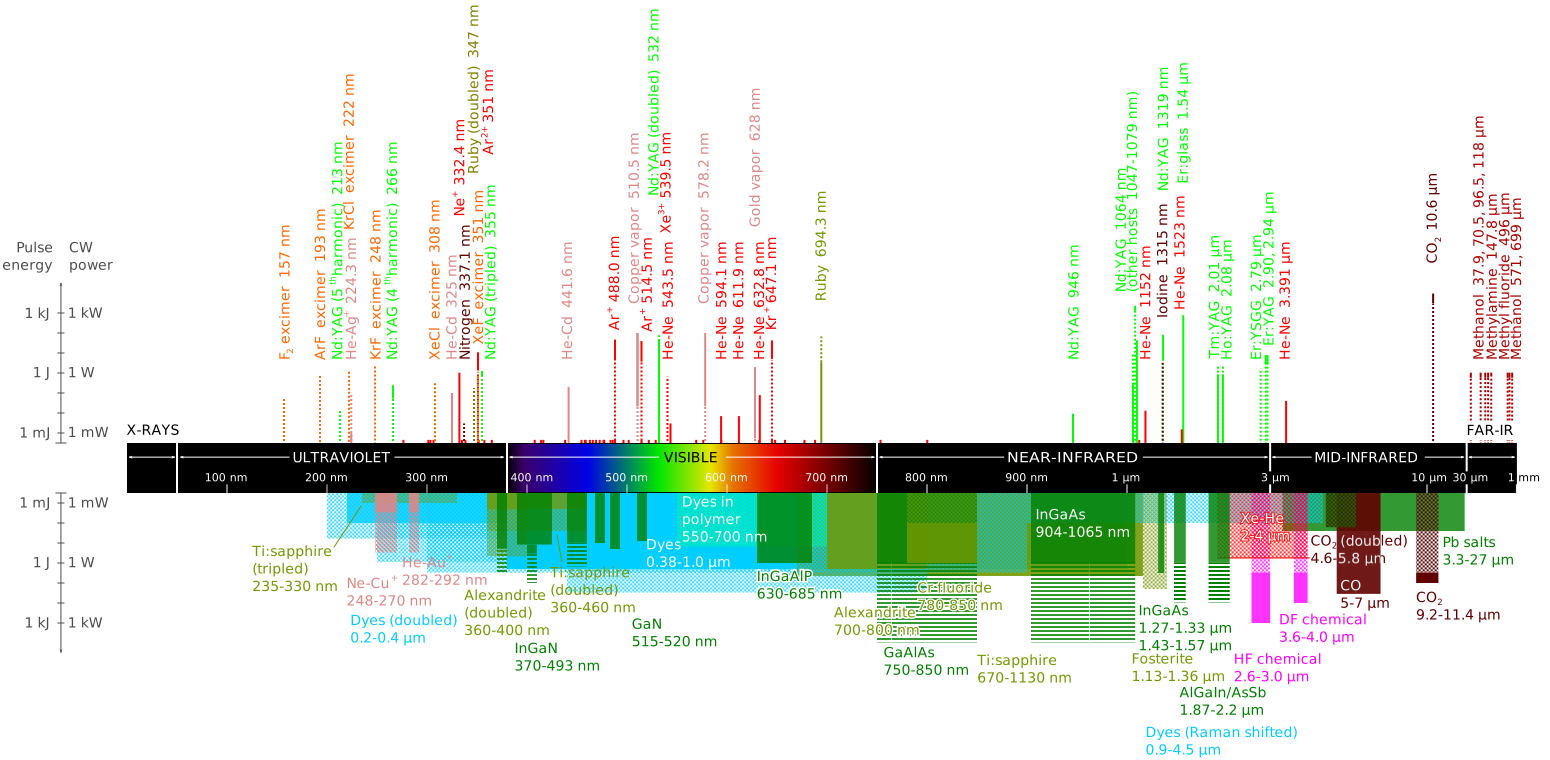
Visible Light: Ranges roughly from 400 nm (violet) to 700 nm (red). Some lasers (like green DPSS at 532 nm) operate in this range.
-
Infrared (IR): Wavelengths longer than visible red light. Most industrial lasers (like Fiber at 1064 nm and CO2 at 10.6 µm) work in the IR spectrum, invisible to the human eye.
-
Ultraviolet (UV): Wavelengths shorter than visible violet light (e.g., 355 nm). These are powerful for precise, "cold" processing.
Why Does Wavelength Matter So Much? Material Interaction is Key
The core reason wavelength is paramount is because different materials absorb light energy differently at different wavelengths. Think of it like matching a key to a lock:
-
Absorption: For a laser to effectively process a material (mark it, cut it, clean it), the material must absorb the laser's light energy at that specific wavelength. If the material reflects or transmits the light instead, little to no effect occurs.
-
Interaction Mechanism: The absorbed energy heats the material. The wavelength influences how this heating happens:
-
Thermal Processing (IR Lasers): Longer IR wavelengths (like Fiber 1064nm, CO2 10.6µm) primarily cause heating, leading to melting, vaporization (engraving), or surface oxidation/color change (marking). This is great for metals, many plastics, wood, etc.
-
Photochemical/"Cold" Processing (UV Lasers): Shorter UV wavelengths have high photon energy. They can break molecular bonds directly without significant heat transfer to the surrounding material. This is ideal for "cold marking" sensitive plastics (avoiding melting), creating high-contrast marks, and precision micromachining.
-
Common Industrial Laser Wavelengths & Their Sweet Spots
| Wavelength | Laser Type | Primary Material Interaction | Typical Applications | Key Advantages |
|---|---|---|---|---|
| 1064 nm | Fiber, Nd:YAG | Strong Thermal Absorption | Marking/Engraving: Metals, Many Plastics, Ceramics, Anodized Al | High power, robust, cost-effective for metals |
| 10.6 µm | CO2 | Thermal Absorption | Cutting/Engraving: Wood, Acrylic, Glass, Leather, Textiles, Paper, Some Plastics | Excellent for organics & non-metals |
| 9.3 µm | CO2 (Variant) | Enhanced Absorption | Specific plastics (PET, PP, PE) that poorly absorb 10.6µm | Better marking on challenging plastics |
| 532 nm | Green DPSS | Thermal Absorption (Better than IR on some) | Marking: Plastics, Semiconductors, Precious Metals (Gold, Copper), PCBs | Higher absorption on reflective/colored materials vs IR |
| 355 nm | UV DPSS | Photochemical/"Cold" Ablation | Marking/Engraving: Sensitive Plastics, Glass, Medical Devices, High-Contrast Marks, Fine Features | Minimal heat damage, high precision, high contrast |
| ~450 nm | Blue Diode | Thermal Absorption (Specific) | Marking: Copper, Gold, Certain Plastics | Excellent absorption on highly reflective metals like copper |
Choosing the Right Wavelength: It's All About the Material
Selecting a laser isn't just about power; it's fundamentally about matching the wavelength to the material you need to process. Ask yourself:
-
What material(s) am I working with? (Metal, plastic type, wood, glass, ceramic, etc.)
-
What process am I doing? (Deep engraving, surface marking, high-speed annealing, cutting, cleaning, micro-machining?)
-
What quality/effect do I need? (High contrast, no heat damage, deep ablation, color change?)
-
Metals: Fiber (1064nm) is the standard workhorse. Green (532nm) or Blue (~450nm) offer advantages for highly reflective metals like copper or gold.
-
Plastics: This is complex! Absorption varies wildly:
-
Dark/Black Plastics: Often absorb IR (1064nm) well.
-
Clear/White Plastics: Often transmit IR but absorb UV (355nm) strongly. CO2 (10.6µm or 9.3µm) is also widely used.
-
Sensitive Plastics (PET, PE, PP, Silicone): UV (355nm) or specific CO2 wavelengths (9.3µm) are often best to avoid melting.
-
-
Organic Materials (Wood, Leather, Acrylic): CO2 (10.6µm) is typically the most effective.
-
Glass & Ceramics: CO2 (10.6µm) for engraving/cutting, or UV (355nm) for precise marking/frosting without cracking.
-
High-Precision / No Heat Effect: UV (355nm) is the go-to choice.
Beyond Wavelength: Other Important Factors
While wavelength is foundational, other laser parameters are crucial for optimal results:
-
Peak Power / Pulse Energy: Impacts marking depth and speed.
-
Pulse Duration (Width): Affects heat input and material interaction (nanoseconds vs. picoseconds vs. femtoseconds).
-
Beam Quality (M²): Determines how tightly the beam can be focused, impacting spot size and detail.
-
Average Power: Influences overall processing speed.
Conclusion: Wavelength is the Starting Point
Understanding laser wavelength machine unlocks the ability to select the right tool for the job. It dictates whether the laser energy will be absorbed effectively by your target material, enabling processes from robust metal engraving to delicate plastic marking without damage. Choosing the wrong wavelength can lead to poor results, inefficiency, or even damage.