Laser Machine: CO2 Vs. Fiber Vs. UV
In modern manufacturing, selecting the optimal laser technology is critical for precision, efficiency, and cost-effectiveness. CO2, Fiber, and UV lasers each excel in distinct areas. Understanding their core differences empowers smarter investment decisions.
Core Technology & Wavelength
-
CO2 Lasers:
-
Mechanism: Gas laser using electrically excited CO₂ gas mixture.
-
Wavelength: Long-wave infrared (10.6 μm).
-
Beam Delivery: Mirrors (susceptible to misalignment).
-
-
Fiber Lasers:
-
Mechanism: Solid-state laser where the gain medium is an optical fiber doped with rare-earth elements (e.g., Ytterbium).
-
Wavelength: Near-infrared (1.06 - 1.08 μm).
-
Beam Delivery: Flexible fiber optic cable (robust, alignment-free).
-
-
UV Lasers:
-
Mechanism: Typically diode-pumped solid-state (DPSS) lasers using frequency tripling to convert IR light to UV.
-
Wavelength: Ultraviolet (usually 355 nm).
-
Beam Delivery: Mirrors or specialized fibers (high-energy UV degrades standard fibers).
-


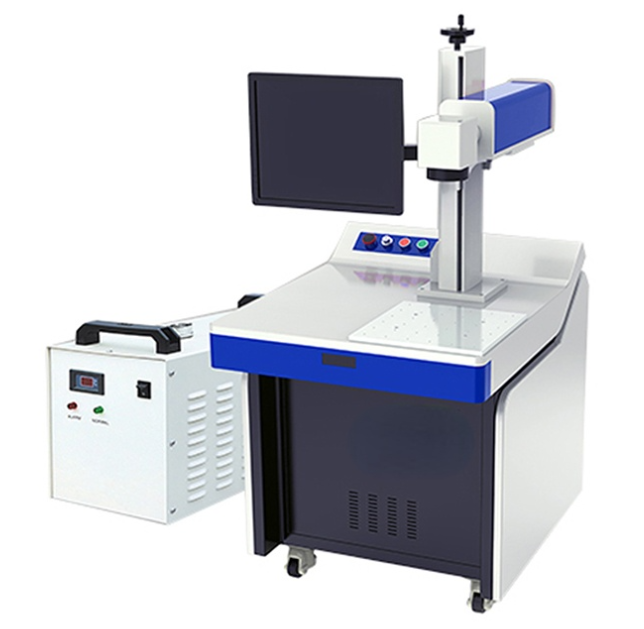
CO2 Laser marking machine Fiber Laser marking machine UV Laser marking machine
Technology Comparison: Strengths & Limitations
| Feature | CO2 Laser marking machine | Fiber Laser marking machine | UV Laser marking machine |
|---|---|---|---|
| Primary Materials | Excellent: Wood, acrylic, leather, glass, fabrics, paper, some plastics. Fair: Thin metals (non-reflective). Poor: Highly reflective metals (Cu, Al). | Exceptional: Metals (steel, Al, Cu, brass), engineered plastics. Good: Some organics (marking). Poor: Transparent materials (glass), pure organics. | Superior: Plastics (incl. sensitive/transparent), ceramics, glass, semiconductors, PCB substrates. Good: Fine marking on metals. |
| Material Interaction | Thermal: Melting/vaporization. Larger heat-affected zone (HAZ). | Thermal: High-intensity absorption melts/vaporizes material. Smaller HAZ than CO₂. | Photochemical "Cold" Ablation: Breaks molecular bonds without significant heat. Minimal/no HAZ. |
| Precision & Detail | Good detail, wider kerf than fiber/UV. Edge charring possible on organics. | High precision, very narrow kerf. Clean edges on metals. | Ultra-High Precision: Smallest spot size (µm range). Perfect for micro-machining, fine features. Burr-free. |
| Speed | Fast cutting/engraving on organics. Slower on thin metals. | Very Fast: Cutting/welding metals (esp. thin-mid gauge). High peak power. | Generally slower cutting. Fast for high-detail marking/micro-machining. |
| Operating Costs | Higher electrical consumption. Requires regular gas refills/replacement. Mirror alignment/maintenance. | Lowest Cost of Ownership: High wall-plug efficiency (up to 40-50%). Minimal consumables. Low maintenance. | Higher cost per watt. Frequent crystal/replacement part costs (DPSS). Optics susceptible to damage. |
| Beam Quality | Good beam quality. Diverges more than fiber. | Exceptional Beam Quality (M²~1.05): Focuses to smallest spots for intense power density. | Very high beam quality. Essential for micro-features. |
| Complexity | Bulkier systems. Sensitive to vibration/misalignment. | Compact, robust, modular. Easy integration. | Complex cooling/stability requirements. Sensitive optics. |
| Safety | IR radiation (invisible). Requires enclosure. | IR radiation (invisible). Requires enclosure. | UV Hazard: Requires strict enclosure (eye/skin damage). Ozone generation possible. |
Applications
-
Choose CO2 Lasers When:
-
Cutting/engraving non-metals is your primary task (wood, acrylic, textiles, packaging).
-
Budget constraints exist for initial investment (though TCO may be higher).
-
Very thick non-metal cutting is needed (e.g., >25mm acrylic).
-
-
Choose Fiber Lasers When:
-
Metal cutting, welding, or deep engraving are core operations.
-
Speed, energy efficiency, and low maintenance are top priorities.
-
Processing reflective metals (copper, brass, aluminum).
-
High-power industrial marking on metals/plastics.
-
-
Choose UV Lasers When:
-
Ultra-fine processing of sensitive materials is critical (medical devices, electronics, optics).
-
Zero thermal damage (HAZ) is non-negotiable (thin films, heat-sensitive plastics).
-
High-contrast marking on plastics/glass without substrate damage is needed.
-
Micro-machining, semiconductor processing, or PCB fabrication.
-
Conclusion: Matching Technology to Task
-
Fiber Lasers dominate industrial metal processing, offering unmatched speed, efficiency, and reliability. They are the modern workhorse for sheet metal fabrication and high-volume marking.
-
CO2 Lasers remain essential for non-metal fabrication and offer cost-effective solutions for specific organic material processing.
-
UV Lasers are the precision specialists, enabling breakthroughs in micro-manufacturing and handling materials where heat is the enemy.