
How Realize The Welding Automatically-Robot Arm
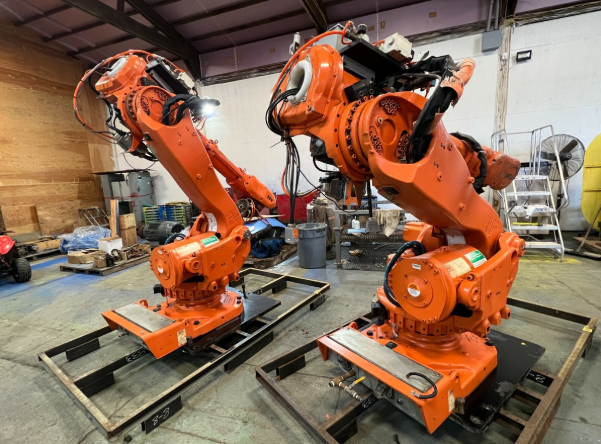
The manufacturing industry is continuously evolving towards greater automation, and laser welding is at the forefront of this transformation. By integrating advanced laser technology with sophisticated robotic arms, automated laser welding systems are revolutionizing production lines, delivering unparalleled precision, speed, and consistency while truly freeing human operators from manual, repetitive tasks.

How Robotic Arms Automate Laser Welding
An automated robotic laser welding cell is a seamlessly integrated system where each component works in harmony. The process can be broken down into several key steps:
-
Programming and Path Planning: The welding process begins offline. Using specialized CAD/CAM software, engineers digitally define the precise weld path directly on a 3D model of the workpiece. The software then generates the complex code that simultaneously controls the robot's movement and the laser's parameters (power, speed, pulse frequency). This path can be optimized for the shortest cycle time and highest quality.
-
Part Positioning and Fixturing: The workpiece to be welded is securely placed in a custom jig or fixture. This ensures the part remains perfectly stationary and correctly oriented throughout the welding cycle, which is critical for repeatability.
-
Automated Execution: At the push of a button, the system springs into action. The multi-axis robotic arm, with the laser welding head attached to its end-effector, follows the pre-programmed path with microscopic accuracy. The laser beam is delivered through a fiber optic cable to the head, which is equipped with protective lenses and often a coaxial gas nozzle for shielding.
-
Real-Time Monitoring and Control: Advanced systems are equipped with vision systems and sensors. These can include seam trackers that automatically adjust the robot's path to compensate for minor part variations, and thermal sensors that monitor the weld pool to ensure consistent quality.
-
Unloading and Repeatability: Once the weld is complete, the robot returns to its home position. The finished part can be manually removed or, in a fully automated production line, another robot can unload it and load a new raw part, enabling true "lights-out" manufacturing.

Key Characteristics of Robotic Laser Welding Arms
The integration of robotics brings a host of powerful advantages:
-
Superhuman Precision and Repeatability: Robotic arms eliminate the inherent variability of human welders. They can repeat the exact same motion millions of times with positional accuracy down to fractions of a millimeter, producing flawless, identical welds on every single part.
-
Unmatched Flexibility and Accessibility: With six or more axes of movement, a robotic arm can maneuver the laser head into positions that are impossible or highly dangerous for a human. It can easily weld complex, three-dimensional contours and reach confined spaces inside assemblies.
-
Dramatically Increased Productivity: Robots do not fatigue, take breaks, or need shift changes. They can operate 24/7, significantly increasing throughput and reducing cycle times. This leads to a faster return on investment (ROI) for high-volume production.
-
Enhanced Quality and Consistency: By maintaining optimal speed, angle, and distance, robotic arms ensure every weld has perfect penetration and a uniform appearance. This consistency is crucial for industries with stringent quality standards, such as automotive and aerospace.
-
Improved Workplace Safety: Automation removes human operators from direct exposure to the laser beam, intense brightness (arc flash), and fumes generated during the welding process. This creates a safer working environment and reduces the risk of injuries.

Beyond Welding: Other Applications of Robotic Arms in Laser Processing
The versatility of a robotic arm equipped with a laser source extends far beyond welding. The same system can be quickly reprogrammed for various other high-value applications:
-
Laser Cutting: Robots can perform 3D contour cutting on pre-formed parts, such as cutting holes in automotive exhaust systems or trimming composite parts in aerospace.
-
Laser Cleaning: The robot can be programmed to selectively remove rust, paint, or coatings from large or complex-shaped objects, like ship hulls, aircraft components, or historical monuments.
-
Laser Cladding and Additive Manufacturing: Also known as Directed Energy Deposition (DED), this process uses the robot to build up material layer by layer for repairing high-value components or creating near-net-shape parts.
-
Laser Surface Hardening: The robot can precisely heat-treat specific areas of a metal part to increase its surface hardness and wear resistance.
Embracing the Future of Manufacturing
Automated robotic laser welding is no longer a niche technology but a cornerstone of modern smart manufacturing. It offers a compelling combination of superior quality, unmatched efficiency, and enhanced operational safety. By automating the welding process, companies can not only "free their hands" but also unlock new levels of productivity and competitiveness.
Robotic Arms in Manufacturing- How They Can Be Used
