Laser Cleaning for Titanium Alloy: Surface Quality and Mechanism
Introduction
Titanium alloys are widely used in aerospace and medical industries due to their high strength and corrosion resistance. However, surface oxides and contaminants must be removed before welding or coating. Traditional chemical and mechanical methods have limitations. In recent years, laser cleaning for titanium has gained attention as a non-contact, eco-friendly alternative. Understanding how process parameters affect surface quality and the underlying oxide removal mechanism is essential for industrial adoption. This review synthesizes key findings based on systematic investigations of laser cleaning for titanium, with emphasis on surface integrity and physical mechanisms.
Process Parameters and Surface Quality
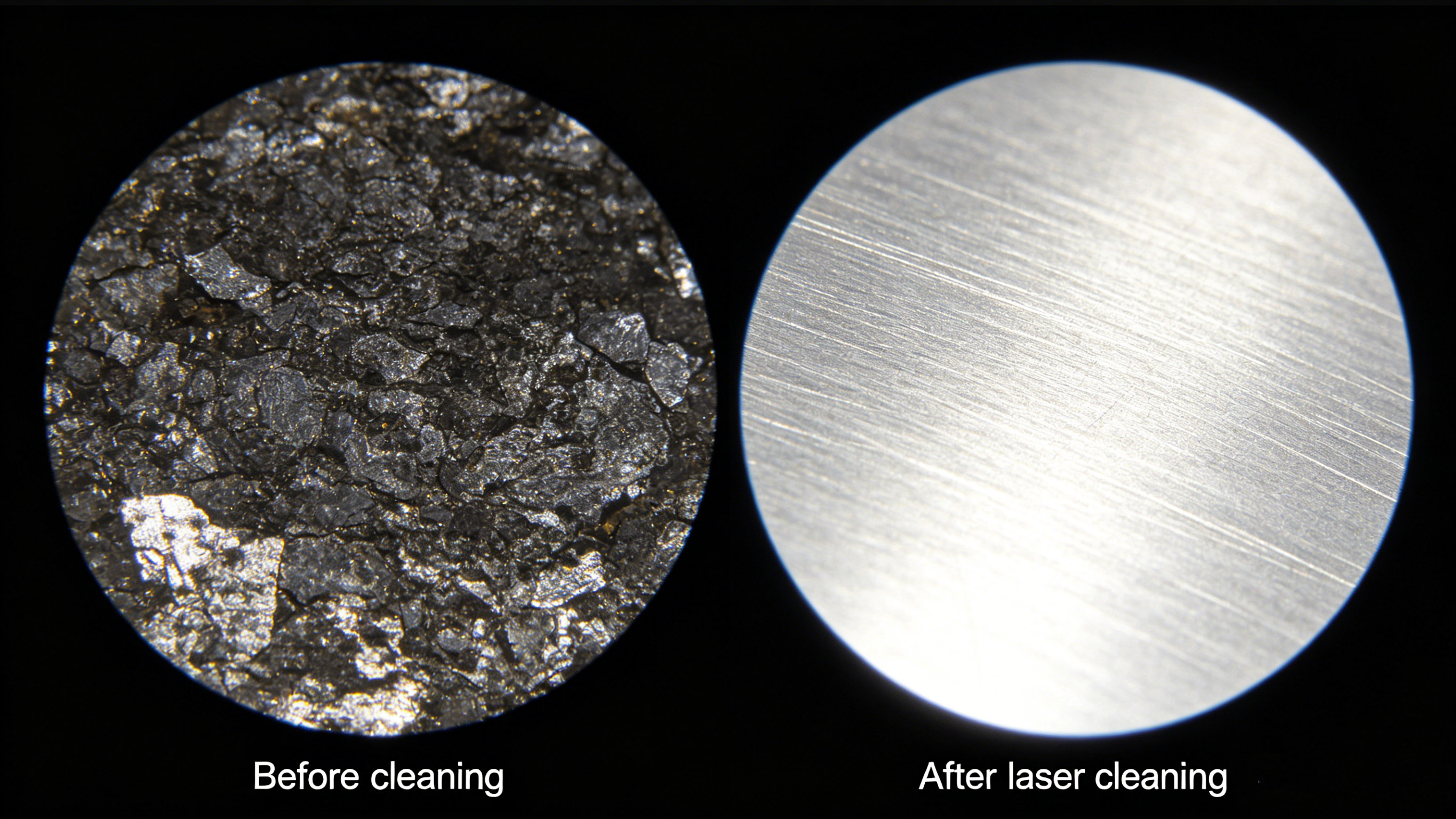
The effectiveness of laser cleaning for titanium depends strongly on laser fluence. At low fluence (below 4.08 J/cm²), oxide residues remain. At an optimal fluence of 6.11 J/cm², surface quality improvement is evident: the surface becomes clean and metallic without substrate damage. At excessive fluence (>8.15 J/cm²), cracking and secondary oxidation occur. This optimal window delivers a surface quality improvement of 32% in roughness reduction and 35% in oxygen content decrease. Studies on TA15 and TC4 alloys confirm that surface quality improvement via laser cleaning for titanium is achievable only when fluence is precisely controlled. A surface quality improvement of this magnitude directly enhances downstream weldability and coating adhesion.
Oxide Removal Mechanism
The primary oxide removal mechanism during laser cleaning for titanium is thermal ablation. Pulsed laser energy raises the surface temperature slightly above the oxide film’s boiling point, causing rapid vaporization and ejection of the contaminant layer. This oxide removal mechanism has been confirmed by scanning electron microscopy and X-ray photoelectron spectroscopy. At optimal fluence, the oxide removal mechanism operates cleanly without substrate melting. However, at higher fluence, secondary oxidation can re-form a thin oxide layer, indicating that the oxide removal mechanism must be carefully controlled to avoid post-cleaning contamination. Understanding this oxide removal mechanism allows engineers to select safe fluence windows for laser cleaning for titanium in production environments.
Industrial Implications and Future Outlook
The aerospace industry has adopted laser cleaning for titanium for critical components such as engine inlets and weld joints. The combination of surface quality improvement and a well-understood oxide removal mechanism makes this technology particularly attractive for high-reliability applications. As the global laser cleaning market grows, further research will focus on real-time monitoring to ensure consistent surface quality improvement and stable oxide removal mechanism across large-area titanium alloy components.
Conclusion
The systematic investigation of titanium alloy laser cleaning has established a clear understanding of process parameter effects, achievable surface quality, and underlying mechanisms. Optimal fluence windows around 5–7 J/cm² deliver complete oxide removal while preserving mechanical properties and reducing surface roughness by over 30%. The primary mechanism — thermal ablation — offers a clean, non-contact, environmentally sustainable approach to surface preparation that directly addresses the limitations of chemical and mechanical methods. As aerospace and other high-reliability sectors continue to adopt titanium alloy laser cleaning for critical applications, further advances in online process monitoring and quality assurance will facilitate broader industrial deployment.
Why Every Industrial Business Will Need Laser Cleaning in the Next Five Years
How Laser Cleaning Works (5 Simple Steps)
Related Article