Laser Processing Market Key Data 2025: Global Growth, Trends, and Regional Insights
The global laser processing market continues its remarkable expansion in 2025, driven by accelerating industrial automation, precision manufacturing demands, and the rapid adoption of Industry 4.0 technologies. According to comprehensive industry analysis, the laser processing equipment market reached a valuation of $28.51 billion in 2025, establishing a solid foundation for projected growth to $31.07 billion in 2026 and an impressive $88.83 billion by 2034, representing a compound annual growth rate (CAGR) of 14% throughout the forecast period1. This comprehensive report examines the critical data shaping the laser processing market in 2025, with particular focus on regional dynamics, technological dominance, and emerging application sectors that define the current landscape.
1. Regional Market Dominance: Asia-Pacific Leads Global Growth
The laser processing market demonstrates pronounced regional concentration, with Asia-Pacific emerging as the undisputed leader. In 2025, the Asia-Pacific region captured 49.20% of global market share, valued at approximately $14.02 billion1. This dominance stems from robust automotive and metal manufacturing sectors, aggressive government industrialization policies, and expanding consumer markets across China, India, Japan, and South Korea. China specifically dominates the regional laser processing market, with its market projected to reach $7.49 billion by 2026, driven by accelerating infrastructure development requiring advanced laser manufacturing methods for complex fabrication challenges1.
The Chinese laser equipment market reached RMB 89.7 billion ($12.3 billion) in 2024, accounting for 56.6% of global laser device market revenue, despite experiencing a 1.4% year-over-year decline—the first contraction in recent years . This temporary setback reflects broader economic adjustments rather than diminishing technological relevance. Meanwhile, India's laser processing market is projected to reach $2.3 billion by 2026, while Japan's market is expected to hit $3.05 billion, underscoring the region's continued growth trajectory1.
North America and Europe maintain significant but slower-growing positions. The United States laser processing market is forecast to reach $4.04 billion by 2026, while Germany's market is projected at $1.35 billion and the United Kingdom at $1.16 billion during the same period1. European growth is characterized by sustainable manufacturing initiatives and energy-efficient processing technologies that align with stringent environmental regulations.
2. Technology Segmentation: Fiber Laser Dominance and Emerging Innovations
Fiber laser technology continues its ascent as the dominant force within the laser processing market, driven by superior efficiency, beam quality, and reliability compared to traditional CO₂ and solid-state alternatives. The increasing adoption of fiber laser technology for producing implantable medical devices and surgical instruments requiring high-precision engineering with minimal oxidation has significantly propelled this segment's growth1. Solid-state lasers maintain substantial market presence, holding 30.58% share in 2026 projections, while CO₂ lasers remain relevant for specific applications in sheet metal and heavy structure manufacturing where higher deposition rates and superior weld strength are prioritized1.
The integration of artificial intelligence represents a transformative trend reshaping the laser processing market landscape. AI-powered laser systems now enable real-time process monitoring, adaptive parameter adjustment, and predictive maintenance capabilities that significantly enhance operational efficiency. For instance, Gasparini Industries Srl introduced its X-Fiber laser machine at LAMIERA 2025, incorporating AI technology that automatically intervenes, inspects, and corrects bending parameters, minimizing downtime while achieving precise, consistent angle formation3. Similarly, Fraunhofer Institute for Laser Technology ILT has developed software modules creating holistic process fingerprints that allow operators to compute and evaluate various signals and image elements, distinguishing between process defects such as surface porosity, seam collapse, spatter, and focal position deviations3.
Fiber laser technology also benefits from ongoing research and development investments that continue pushing power boundaries and application versatility. The convergence of AI with fiber laser technology enables sophisticated quality assurance mechanisms that were previously impossible with conventional rule-based algorithms. Machine learning algorithms can now optimize correction strategies based on actual measurement or simulated data, ensuring consistent process performance across varying material conditions and complex geometries3.
3. Application Sectors: Automotive, Electronics, and Emerging Markets
The automotive sector remains the largest end-user within the laser processing market, projected to capture 42.16% market share by 20261. This dominance reflects laser technology's critical role in continuous production lines, where laser cutting and welding equipment provide superior operational capabilities essential for high-performance vehicle manufacturing. The expanding electric vehicle market particularly drives adoption of laser cutting, welding, and punching machines across automotive, metal fabrication, and consumer electronics sectors . Chinese electric vehicle exports surged 32% in early 2025, with battery housing welding precision requirements reaching 0.1mm accuracy—specifications achievable only through advanced laser systems.
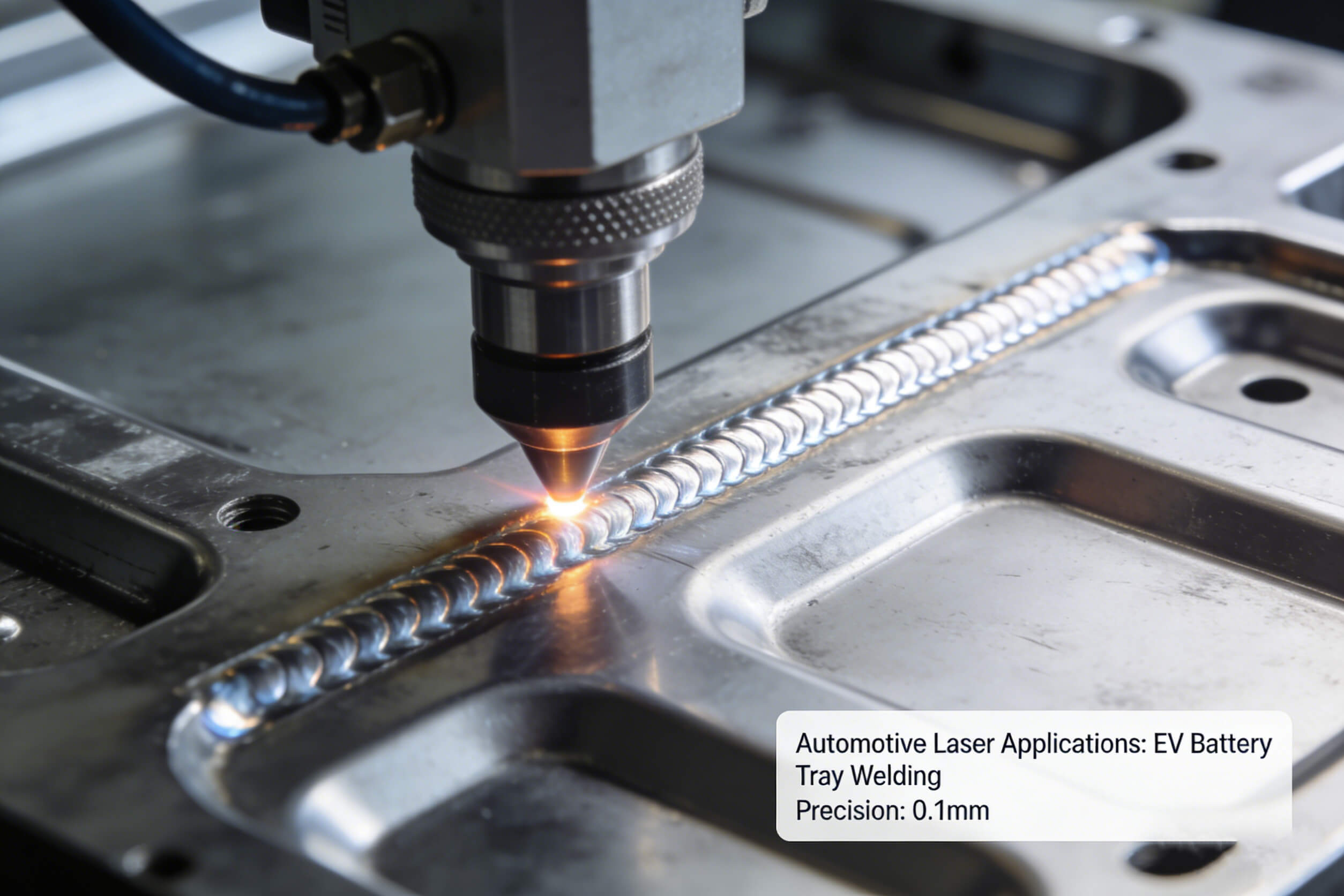
Beyond automotive, the laser processing market demonstrates robust growth across multiple application domains. Laser welding equipment specifically has gained momentum in fine micro-processing applications including power batteries, automotive components, and consumer electronics. China's laser welding complete equipment market reached approximately RMB 12.25 billion ($1.68 billion) in 2024, showing 6.3% year-over-year growth, with projections reaching RMB 12.5 billion in 2025 . This growth reflects increasing demand for precision welding in electric vehicle battery production and lightweight automotive structures.
The medical sector presents another significant growth frontier for the laser processing market, with applications spanning ophthalmology, dermatology, plastic surgery, dentistry, laparoscopic surgery, and various surgical specialties. The United Kingdom alone performs approximately 330,000 cataract surgeries annually, illustrating laser technology's expanding role in medical procedures2. Medical laser applications leverage focused coherent light sources delivering precisely controlled energy for minimally invasive treatments, driving continued demand for specialized laser processing equipment.
Export data further illuminates the laser processing market dynamics, with Chinese laser processing machine tool exports reaching RMB 14.1 billion ($1.93 billion) in 2024, a 2% increase over previous year . Particularly notable is the performance of laser welding robots and devices, which achieved export value of RMB 12.67 billion ($1.74 billion) in first-half 2025, while laser processing machine tool contributed RMB 8.47 billion ($1.16 billion) in exports . High-value segments demonstrated exceptional performance, with optical communication equipment laser transceiver modules accounting for 45.6% of all laser product exports, valued at nearly RMB 19.4 billion ($2.66 billion) .
4. Future Outlook: Market Forecast and Strategic Implications
Looking ahead, the laser processing market shows strong momentum despite short-term challenges. While 2024 witnessed a 47.24% decline in new laser enterprise formation in China—reflecting market consolidation and intensified competition—established players continue strengthening their positions . The top ten companies now command over 50% of the market, with Bordor laser leading at 10.3% market share in China, maintaining its top position for two consecutive years through independent research and development of key components including laser sources, laser heads, and operating systems.
Technological trajectories point toward continued fiber laser technology advancement, with power levels pushing beyond 30kW for cutting applications and increasing integration of intelligent features. Ultrafast lasers and semiconductor lasers are achieving annual growth rates of 25% and 20% respectively, addressing specialized applications in precision micro-machining . The push for core component localization continues, with China targeting 85% domestic production of high-power laser components and 90% for high-power laser chips, though ultraviolet and ultrafast laser segments still require technological breakthroughs.
Emerging applications in renewable energy, semiconductor processing, and aerospace manufacturing will further diversify the laser processing market. Solar photovoltaic manufacturing increasingly relies on laser processing for efficiency improvements, while LNG carrier production utilizes laser welding for殷瓦钢 (Invar steel) containment systems, achieving threefold efficiency improvements and leakage rates below 0.001% . These specialized applications demonstrate the expanding technological frontier and sustained growth potential characterizing the global laser processing market through 2025 and beyond.
Laser Solutions 2026: Powering a New Year of Manufacturing Innovation
ZGLC Laser Annual Dinner: Jack Ma’s 2026 Vision and Festive Celebrations
Related Article