Laser Curtains and Barriers in a Laser Controlled Area: Best Practices
Setting up barriers and curtains in a laser controlled area looks simple. Hang a curtain, block the beam, done. But walk into most workshops and you'll spot the same mistakes: gaps at corners, panels with no overlap, barriers placed too close to the beam path. Getting laser safety right takes more than buying a curtain and hoping for the best. This guide walks through the best practices for setting up laser safety barriers and curtains correctly.
1. What Is a Laser Controlled Area?
A laser controlled area is a designated space where laser radiation hazards exist and access is controlled. Laser safety regulations require that Class 3B and Class 4 laser systems operate within a controlled area. Walls, partitions, and curtains must be made from laser-safe materials capable of withstanding direct and reflected beams at the operating wavelength and power. The area must be posted with warning signs at all entrances, and barriers must prevent laser light from escaping above the Maximum Permissible Exposure (MPE).
2. Start with a Laser Hazard Analysis
Before buying a single laser safety curtain, you need to know exactly what you're dealing with. A proper hazard analysis answers three questions:
-
What is the laser's wavelength and power? A curtain rated for 1064nm won't protect you from a 10.6μm CO₂ laser.
-
What is the beam path? Map out the direct beam, all possible reflections, and scattered radiation.
-
What is the Nominal Hazard Zone (NHZ)? This is the area where laser radiation exceeds the MPE.
The curtain's irradiance rating must exceed the expected exposure at the installation distance. When in doubt, choose a curtain with higher irradiance specifications. Final selection should always be reviewed by a qualified Laser Safety Officer (LSO).
3. Class 3B and Class 4 Barriers Need Different Thinking
Not all lasers need the same containment level.
-
Class 3B lasers (5–500mW) can cause eye damage from direct beam exposure. Curtains mainly need to block direct and specular reflections.
-
Class 4 lasers (over 500mW) are also skin and fire hazards. Curtain materials must be flame-resistant and pass NFPA 701 requirements.
Class 4 areas must include all Class 3B control measures plus blocking barriers that ensure MPE is not exceeded at entry points. Curtains used as part of an NHZ boundary must reduce transmitted radiation below the applicable MPE.
4. Use Beam Enclosures and Beam Stops First
Here's a principle many overlook: laser safety barriers are your last line of defense, not your first. Before installing curtains:
-
Beam tubes and enclosures – Fully enclose the beam path wherever possible
-
Beam blocks and dumps – Terminate the beam at the end of its useful path
-
Interlocks and shutters – Automatically block the beam when access is detected
Only after doing everything possible to contain the beam at the source should you rely on perimeter barriers. Good laser safety practice is layered: engineering controls first, administrative controls second, PPE third.
5. Choose Tested and Labeled Laser Safety Curtains
Never buy a laser safety barrier that hasn't been tested and labeled. Demand these documents from your supplier:
-
Test reports showing the curtain's irradiance rating
-
Wavelength-specific protection data for your laser
-
Optical Density (OD) rating inscribed on the product
-
Flame resistance certification – NFPA 701 compliance
-
EN 12254 or ANSI Z136 compliance depending on your region
Laser safety curtains are designed to contain reflected, scattered, or diffused radiation—not to serve as targets for direct beams. Direct exposure may damage them.
6. Choose the Right Barrier Configuration
Fixed Rigid Panels
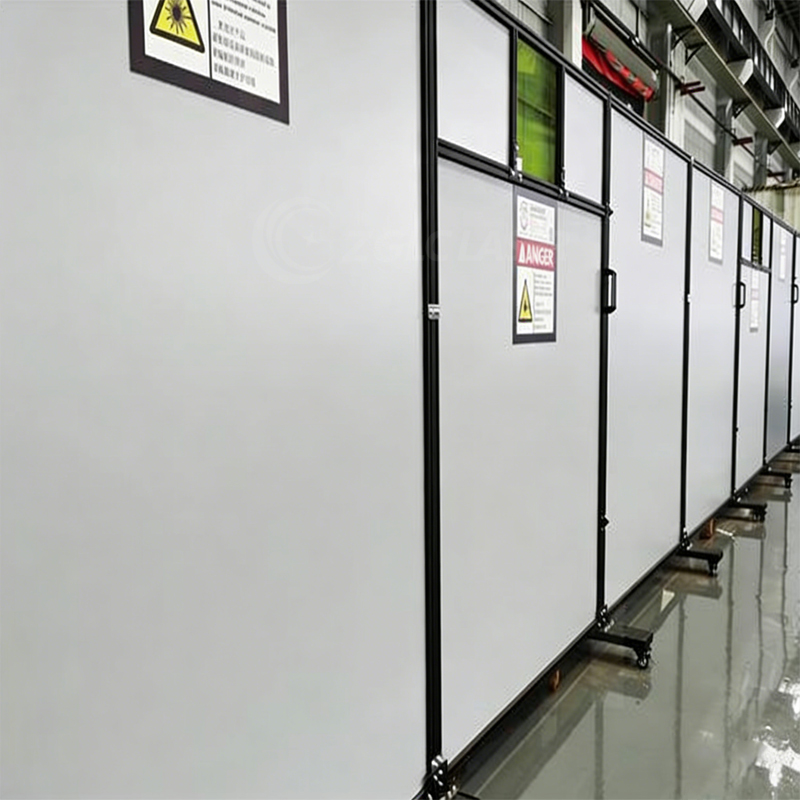
Permanent walls or panels around the laser area. Best for high-power systems and permanent installations. Provide the most durable containment.
Flexible Laser Curtains
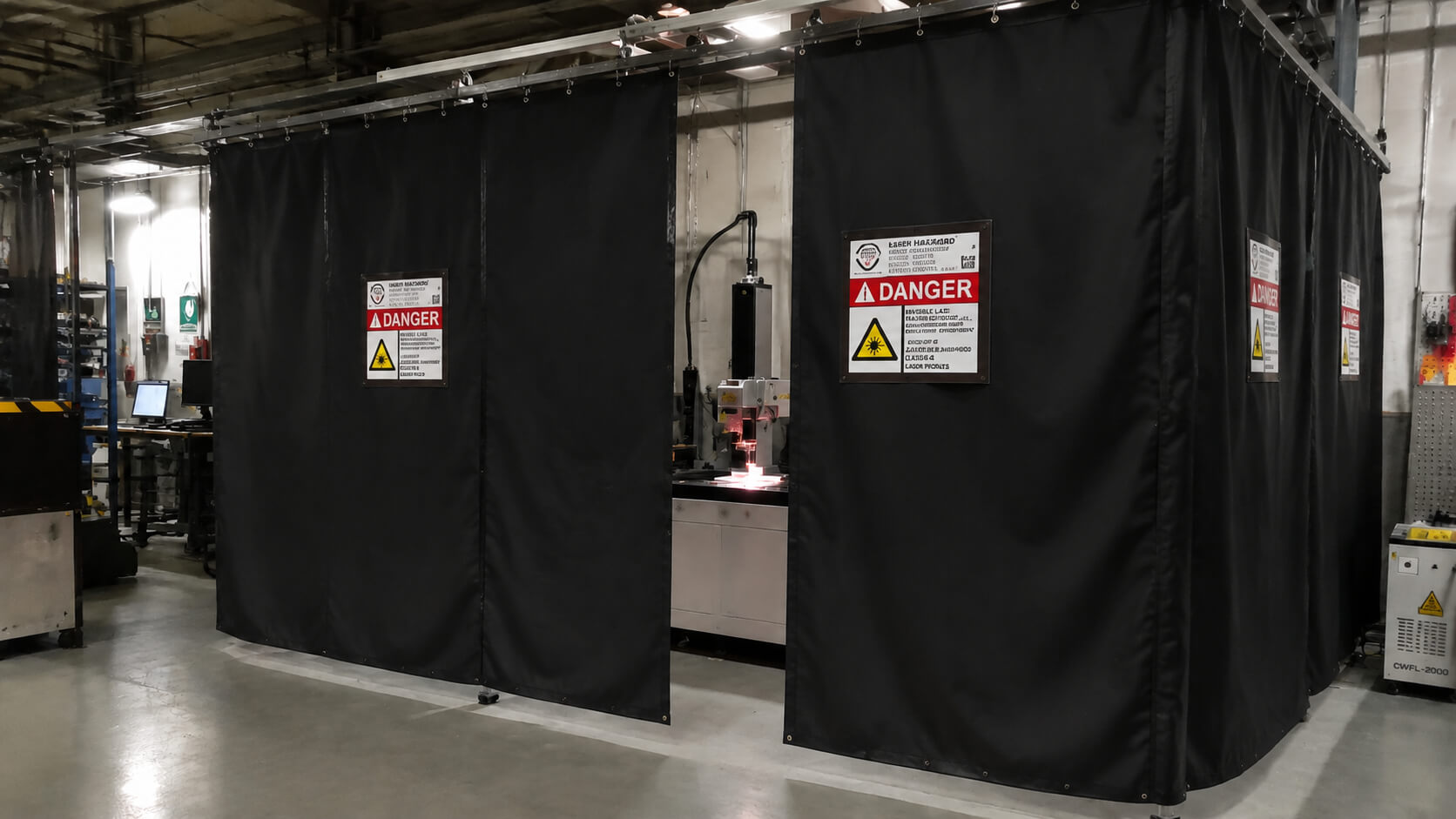
Mounted to walls, ceiling tracks, or freestanding posts. Best for flexible containment and large openings. Often include overlapping sections or access openings.
Portable Laser Safety Screens
Freestanding or wheeled barrier panels. Best for temporary work areas, mobile setups, and research spaces. Quick to deploy, no permanent installation required.
Laser-Grade Viewing Windows
For applications requiring visual monitoring. These windows are rated to block specific wavelengths while allowing safe observation.
7. How to Position Laser Safety Curtains
Map the complete beam path – Draw out the direct beam and all possible reflection paths. Place barriers where the beam could exit the controlled area.
Set barriers beyond the foreseeable hazard zone – Don't place curtains right next to the beam. Give yourself a safety margin.
Cover windows, doors, and open passages – These are common escape routes for stray beams. Use window coverings or curtained entryways.
8. Eliminate Gaps at Seams, Corners, and Entryways
This is where most installations fail. Curtains must be hung with enough overlap between panels to avoid gaps. An overlap of approximately 12 inches (30cm) between vertical curtain pieces is recommended. For ceiling-mounted systems, valances cover gaps near the ceiling. Install track supports every 1 meter for ceiling mounts and every 1.2 meters for floor supports.
9. Ensure Mobile Barriers Are Secure
Portable laser safety barriers must be stable. Use locking casters on wheeled units, floor mounting adapters for stability, sufficient weight at the base to prevent tipping, and interlocking panels that connect securely.
10. Coordinate Installation with the Fire Department
Laser safety curtains can affect fire sprinkler coverage, emergency egress, and fire alarm visibility. Work with your local fire prevention authority to ensure your setup meets fire codes. Some facilities have been required to replace certain curtain materials based on fire safety recommendations.
11. Keep Rapid Emergency Exits Clear
Laser safety barriers must never block emergency exits. All controls must allow rapid egress under emergency conditions. Emergency "Beam Off" buttons should be located within the curtained entryway. Curtains should part easily—consider magnetic or Velcro closures rather than locks.
12. Set Up Class 4 Entry Controls
Class 4 laser controlled areas require additional entry controls:
-
Interlocked doors that shut off the laser when opened
-
Warning lights outside the entry indicating laser operation
-
Entry procedures requiring personnel to don proper PPE before entering
-
Emergency bypass for trained personnel only
13. Control Reflections Inside the Curtain
Laser beams can reflect off shiny surfaces inside the controlled area. Before installing laser safety curtains:
-
Cover or remove reflective objects – tools, equipment, jewelry
-
Use matte finishes on walls and work surfaces where possible
-
Reduce smoothness of reflective objects or apply frosted material
14. Commission Barriers Before Routine Operation
Before regular production:
-
Commission the full system – Run test firings with all barriers in place
-
Verify no beam escape – Use beam cards or detectors at all potential exit points
-
Document the setup – Take photos, record barrier positions, note parameters
-
Train all operators on the specific barrier configuration
15. Inspect Laser Curtains Before Each Use
Create a pre-operation checklist:
-
Are all laser safety curtains properly closed with no gaps?
-
Are the curtains free from damage or burn marks?
-
Are warning signs posted and visible at all entry points?
-
Are beam stops and barriers in position?
-
Is the area free of unauthorized personnel?
16. Recheck the Setup After Every Laser Change
When you replace a laser source, change wavelengths, or adjust power:
-
Re-evaluate the hazard analysis
-
Re-test barrier effectiveness for the new parameters
-
Update documentation and operator training
17. Common Laser Curtain Installation Mistakes
-
No overlap between panels – leaving gaps that beams can escape through
-
Using curtains as beam targets – direct exposure damages the material
-
Blocking fire sprinklers – floor-to-ceiling curtains can prevent sprinklers from reaching a fire
-
Ignoring reflections – shiny surfaces inside the controlled area create secondary hazards
-
No emergency egress plan – barriers that trap people inside
-
Buying untested curtains – no test reports, no wavelength rating
-
Inadequate support spacing – curtains that sag or fall
18. Train Operators and Laser Safety Officers
Even the best laser safety setup fails without proper training. Operators must understand:
-
The hazards of the specific laser system
-
How to use barriers and curtains correctly
-
Emergency shutdown procedures
-
What to do if a barrier is damaged or compromised
Laser Safety Officers need additional training on hazard analysis, MPE calculations, and regulatory compliance. Refresher training should be conducted annually or whenever the laser setup changes.
FAQ
Q: Can I use any curtain as a laser safety curtain?
A: No. Only curtains specifically tested and labeled for laser protection should be used. They must be rated for your laser's wavelength and power. Never subject laser curtains to direct beam exposure.
Q: Do laser safety curtains need to be floor-to-ceiling?
A: Not necessarily. They can start about a foot above the floor and stop short of the ceiling. However, floor-to-ceiling curtains can interfere with fire sprinklers.
Q: What overlap do I need between curtain panels?
A: At least 12 inches (30cm) of overlap between vertical panels is recommended. For ceiling-mounted systems, use valances to cover gaps near the ceiling.
Q: How often should I replace laser safety curtains?
A: Replace curtains periodically because optical density may deteriorate depending on usage, storage environment, direct sunlight, high temperature, high humidity, or scratches.
Q: Can laser safety curtains block a direct beam?
A: No. These curtains are designed to contain reflected, scattered, or diffused radiation, not to serve as targets for direct beams.
Q: Who should review my barrier setup?
A: Final containment selection should always be reviewed by a qualified Laser Safety Officer (LSO) or laser safety professional.
Q: What's the difference between a laser safety curtain and a laser safety barrier?
A: A laser safety curtain is typically a flexible fabric panel. A laser safety barrier is a broader term that includes rigid panels, portable screens, and full enclosures.
Ready to set up proper laser safety barriers and curtains for your operation? Contact ZGLC Laser for expert guidance on laser safety compliance and barrier selection.