Nanosecond Laser Transmission Welding of Stainless Steel and Quartz Glass: Interfacial Mechanisms and Microstructural Evolution
The demand for robust, precision joining of dissimilar materials like metals and glass is escalating in industries such as microelectronics, aerospace, and biomedical devices. A recent study published in Ceramics International provides critical insights into this challenge, specifically investigating nanosecond laser transmission welding of 304 stainless steel and quartz glass. This research delves into the core interfacial mechanisms and the resulting microstructural evolution that enable strong, reliable bonds between these two vastly different materials. This article summarizes the key findings, highlighting how process parameters influence joint formation and strength.
1. The Challenge and Approach of Nanosecond Laser Transmission Welding
Welding transparent materials like quartz glass to opaque metals like stainless steel is inherently difficult due to their differing thermal and optical properties. Traditional methods often struggle with thermal stress and interfacial failure. Nanosecond laser transmission welding offers a promising solution by focusing a laser beam through the glass onto the metal surface below. The metal absorbs the laser energy, melts, and transfers heat to the adjacent glass, creating a joint. However, maintaining intimate contact (optical contact) between the materials is crucial for success.
The referenced study tackles this by using mechanical clamping to ensure optical contact during nanosecond laser transmission welding. It systematically investigates how varying key parameters—laser power, pulse frequency, scanning speed, and number of scanning cycles—affects the bonding outcome. This approach moves beyond simple feasibility, aiming to map the process window and understand the underlying physics.

2. Unraveling the Interfacial Mechanisms
The research reveals that the bond strength is not the result of a single phenomenon but a synergy of physical and chemical interfacial mechanisms. Using advanced characterization like SEM, EDS, and XPS, the authors identified two primary bonding actions:
-
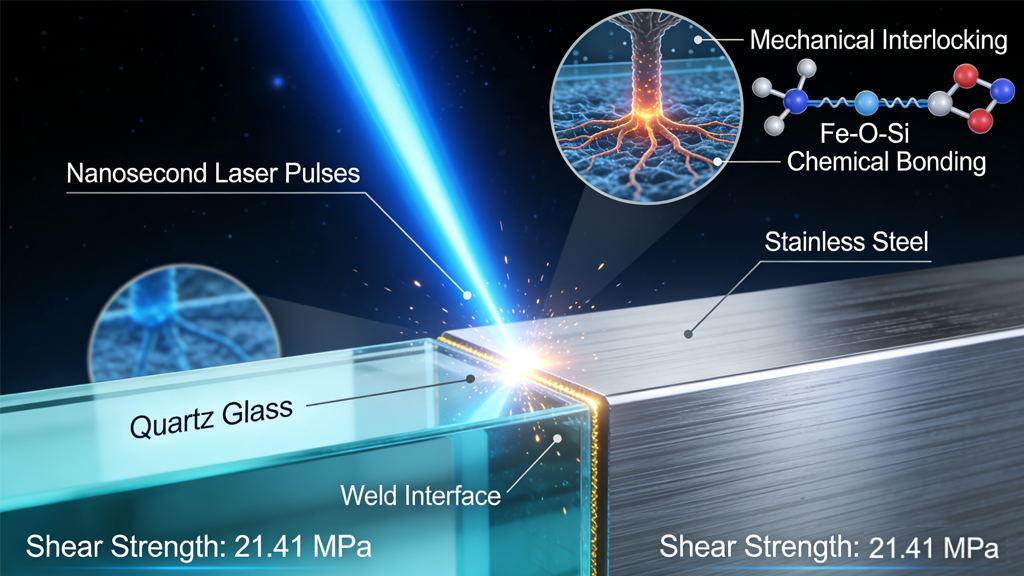
Mechanical Interlocking: Localized melting of the stainless steel surface, driven by the nanosecond laser transmission welding process, creates micro-scale irregularities. The molten quartz glass flows into these features, and upon cooling, forms a strong physical interlock. This mechanical contribution is most prominent in what the study defines as the "smooth" and "fragmented" morphological regions of the weld zone.
-
Chemical Bonding: Critically, high-resolution XPS analysis confirmed the formation of genuine chemical bonds at the interface. Specifically, Me-O-Si (metal-oxygen-silicon) bonds, particularly Fe-O-Si, were detected. This indicates a reaction between iron from the stainless steel and silicon-oxygen networks from the quartz glass, creating strong covalent linkages. This chemical interaction fundamentally reinforces the joint, explaining the high strengths achieved.
3. Microstructural Evolution Across the Weld Zone
A key contribution of this study is the detailed classification of the microstructural evolution within the weld zone. Under the influence of nanosecond laser transmission welding, the interface develops three distinct morphological regions:
-
Smooth Region: This zone, formed under optimal energy input, shows a continuous, defect-free bond line. It contributes most significantly to the overall joint integrity and is associated with cohesive failure within the glass layer during mechanical testing.
-
Fragmented Region: Here, the glass shows signs of microfracture and fragmentation, likely due to higher localized thermal stresses, yet some bonding still occurs.
-
Ablated Region: Resulting from excessive laser energy, this zone exhibits material vaporization and void formation, which weakens the joint.
The microstructural evolution from a smooth to an ablated region is directly linked to the laser parameters. For instance, excessive power or slow scanning speeds push the process from the desirable smooth regime into the damaging ablation regime, drastically reducing joint strength.

4. Achieving Optimal Joint Strength
The study quantified the success of these interfacial mechanisms through shear strength testing. By optimizing the parameters for nanosecond laser transmission welding, the researchers achieved a peak shear strength of 21.41 MPa. This high strength is attributed to the combined effect of mechanical interlocking in the smooth region and the formation of Fe-O-Si chemical bonds. The fracture analysis supported this, showing that failure predominantly occurred cohesively within the glass itself, not at the bond interface, proving the joint was stronger than the base glass material in that region. This demonstrates that nanosecond laser transmission welding, when properly controlled, can create joints that leverage both physical and chemical bonding for superior performance.
5. Implications for Advanced Manufacturing
These findings are significant for industries requiring precise and reliable joining of dissimilar materials. The work clarifies that nanosecond laser transmission welding is a viable and potentially more accessible alternative to expensive ultrafast laser systems for certain applications. By understanding how laser parameters drive microstructural evolution and activate specific interfacial mechanisms, manufacturers can design robust processes for components like medical implants, sensors, and microelectronic packages. This research provides a fundamental roadmap for achieving high-strength, durable glass-metal bonds using a practical, industrial-scale laser technology.
Mastering Dissimilar Metal Welding: How to Join Copper to Stainless Steel
China Laser Welder: The Smart Choice for Modern Manufacturing
Related Article