Influence of Cutting Parameters and Assist Gases on the Laser Cutting Quality of 09G2S (S355J2, EN 10025-2) Structural Steel
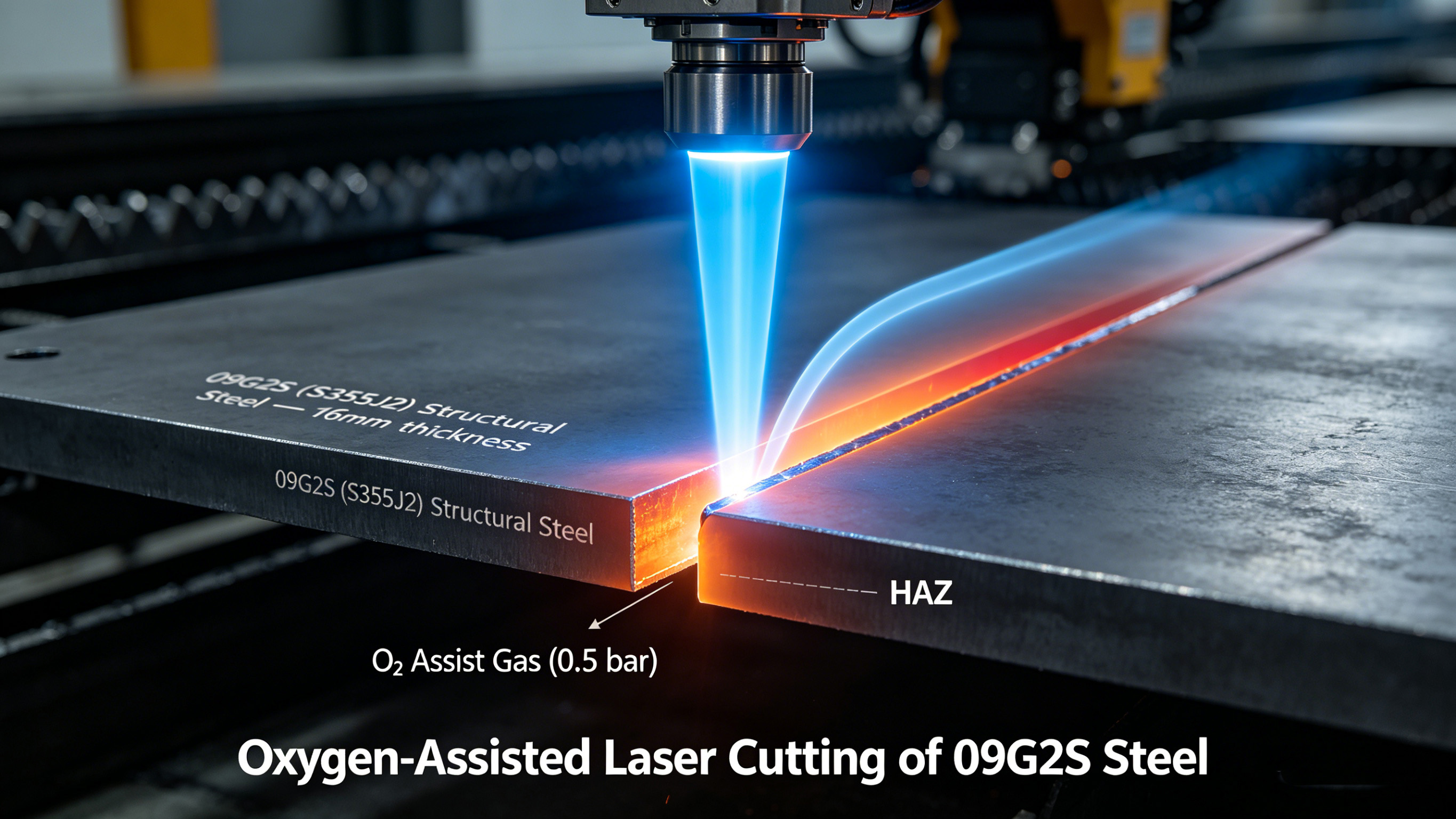
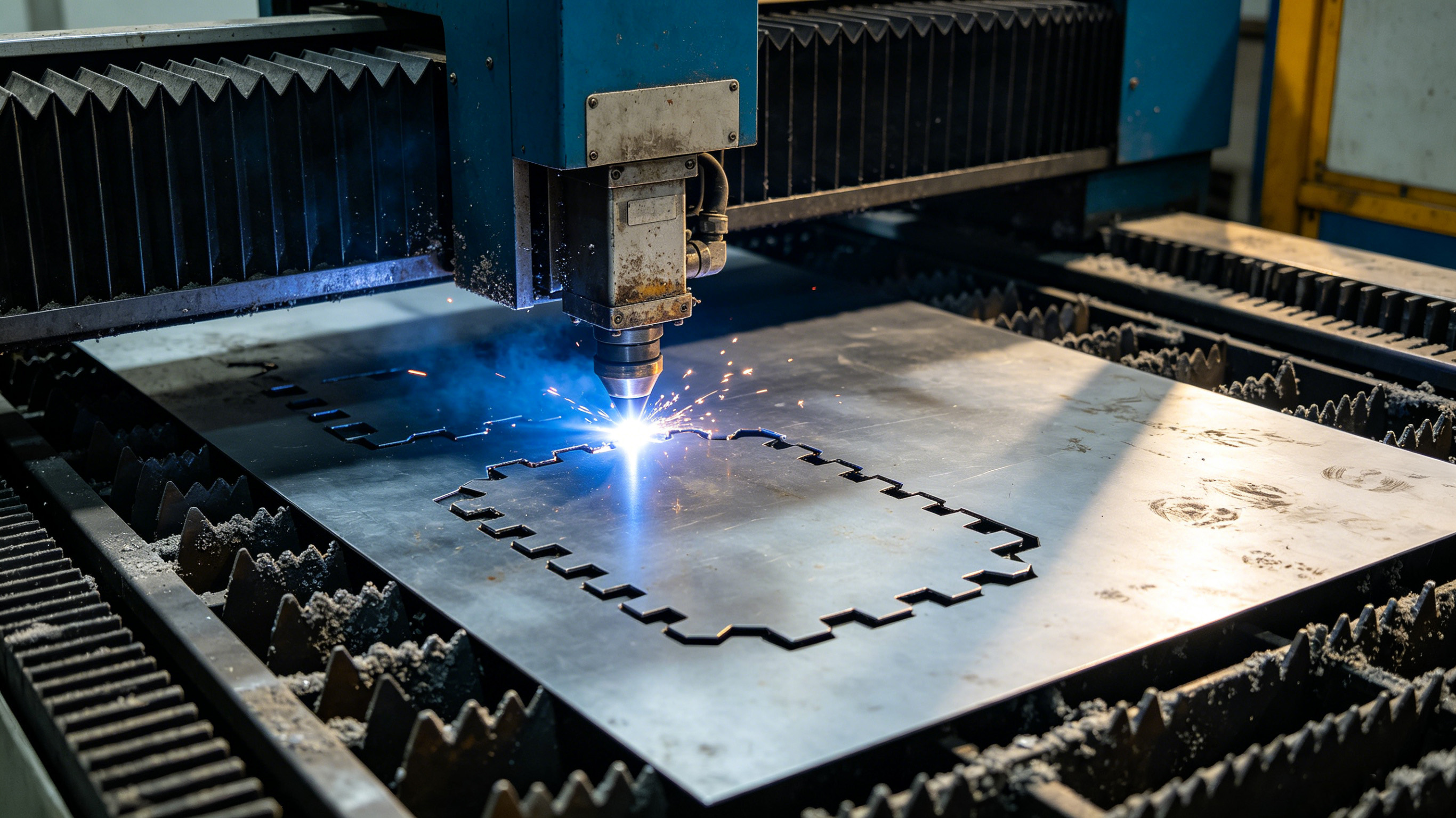
In modern industrial fabrication, laser cutting quality is paramount for structural components made from low-alloy steel grades such as 09G2S (equivalent to S355J2 under EN 10025-2). Widely used in mechanical engineering, mining, and metallurgical industries, 09G2S offers high strength and good toughness. However, its elevated manganese and silicon content makes it sensitive to thermal effects during laser cutting quality optimization. A recent open-access study published in Results in Engineering systematically investigates how cutting parameters and assist gas selection—specifically air versus pure oxygen—govern the laser cutting quality, microstructural evolution, and defect formation in 16 mm thick 09G2S steel sheets using an 8 kW fiber laser.
1. The Critical Role of Assist Gas in Laser Cutting Quality
The choice of auxiliary gas is one of the most influential factors affecting laser cutting quality in structural steels. The referenced study conducted a direct comparative analysis between compressed air and pure oxygen as assist gases. For cutting parameters, the study established optimized regimes for each gas type. With air assist, piercing power was set at 7 kW with 1.2 seconds of piercing time and gas pressure at 7 bar, while cutting was performed at 7 kW power, 1.6 m/min speed, and 7.5 bar pressure. For oxygen assist, significantly lower values were sufficient: 2.5 kW piercing power, 0.7 seconds piercing time, and only 0.5 bar gas pressure during cutting. This dramatic difference stems from the exothermic oxidation reaction of iron when oxygen is used, which actively contributes thermal energy to the cutting process.
2. Air vs. Oxygen: Surface Quality and Oxidation Behavior
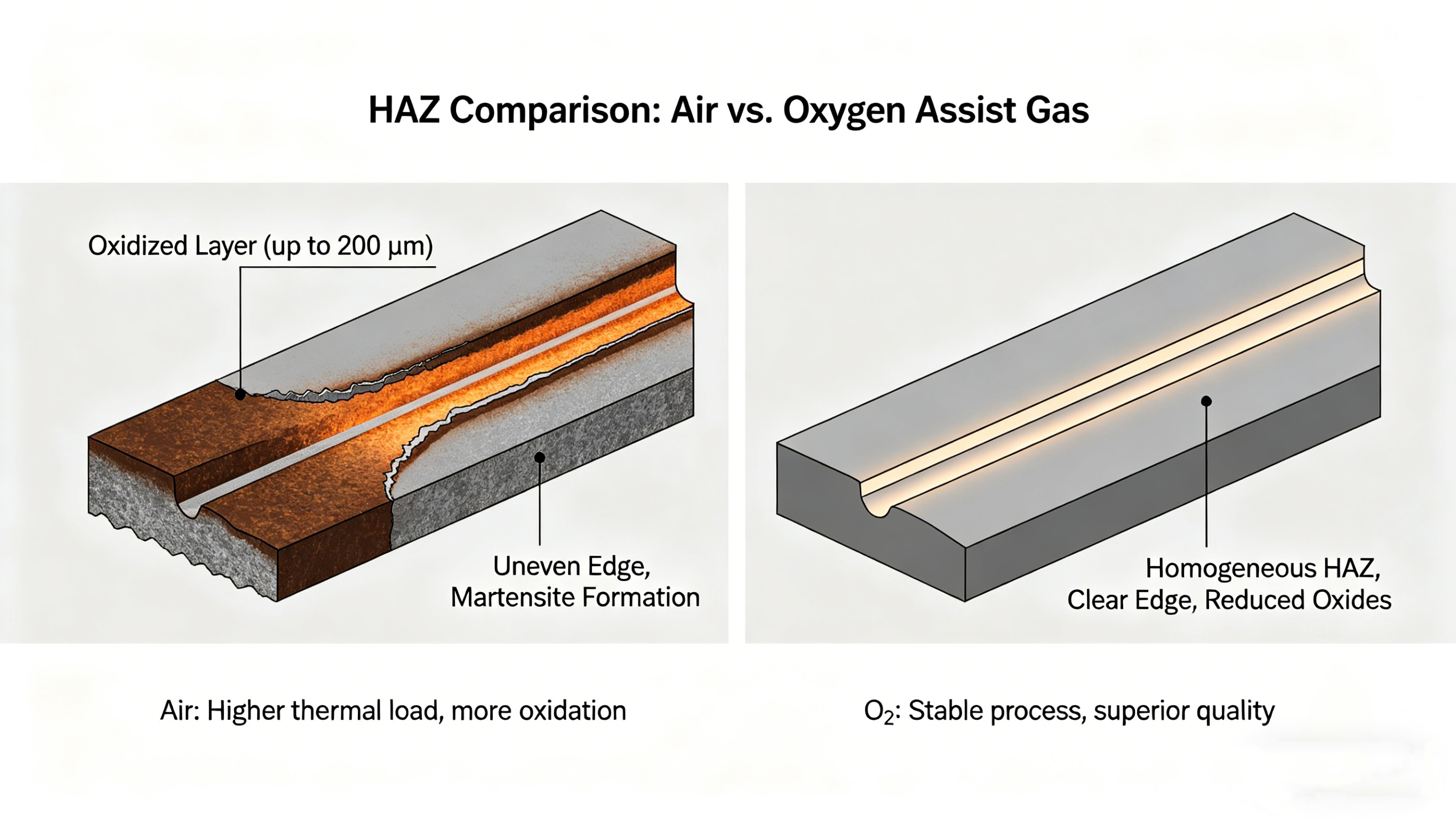
The study’s experimental results reveal stark differences in laser cutting quality between the two assist gases. When cutting with air assist, an uneven cutting surface was observed, accompanied by the formation of an oxidized layer up to 200 μm thick and the development of martensite in the near-surface zone—attributed to increased heat load and inefficient melt removal. In contrast, oxygen assist ensured a much more stable cutting process, delivering an even and clear edge with a homogeneous microstructure in the heat-affected zone (HAZ) and reduced oxide content. Quantitative metrics confirmed this superiority: oxygen cutting achieved a kerf width of 1.0 mm and surface roughness Rz ≤ 20 μm, compared to 1.2 mm and ≤ 25 μm for air cutting.
3. Microstructural Evolution and Phase Composition
Beyond surface characteristics, the study employed X-ray diffraction to analyze phase transformations in the cutting zone—a critical indicator of laser cutting quality that affects downstream operations like welding. Under air assist, the maximum diffraction peak intensity reached 359 counts, indicating a higher concentration of oxide phases and residual stresses within the HAZ. Semi-quantitative analysis revealed that under air blowing, the dominant phase was iron(II) oxide (FeO) at approximately 48%, while metallic α-Fe comprised only about 21%. Under oxygen assist, the diffraction peak intensity dropped to 239 counts, and the phase composition reversed dramatically: α-Fe content increased to approximately 53%, while FeO decreased to roughly 13%. This reversal confirms that oxygen cutting better preserves the metal’s ferrite phase while more effectively expelling oxidation products from the cutting zone.
4. Mechanical Integrity and Resource Efficiency
The study also assessed microhardness distribution—a direct measure of structural stability and laser cutting quality for subsequent welding operations. Under air assist, microhardness values increased near the cut surface, from 125 HV at 0.05 mm depth gradually decreasing to 118 HV at 0.45 mm depth, indicating the formation of a hardened surface layer due to rapid cooling. Under oxygen assist, microhardness was distributed more uniformly across the same depth range, from 120 HV to 117 HV, confirming a more stable structural state. This uniform hardness profile is a beneficial factor for maintaining high strength characteristics in welded joints during subsequent processing. Furthermore, oxygen assist proved far more resource-efficient, with a calculated flow rate of only 2.33 m³/h compared to 46.01 m³/h for air—a twenty-fold reduction in gas consumption.
5. Practical Recommendations for Industrial Applications
For manufacturers processing 09G2S (S355J2) structural steel, the study’s findings offer clear guidance on cutting parameters optimization. When laser cutting quality is the priority—particularly for components requiring subsequent welding or operating in load-bearing applications—pure oxygen assist is strongly recommended. It delivers superior edge quality, a more uniform HAZ microstructure, and significantly lower gas consumption. The optimal oxygen cutting regime includes cutting power of 5 kW, speed of 1.5 m/min, focus position of −0.7 mm, and gas pressure of 0.5 bar with a 1.8 mm nozzle diameter. For applications where cost is the primary constraint, air assist remains an option but with the understanding that post-processing may be required to address oxidation and surface irregularities. Ultimately, the auxiliary gas selection must be aligned with the specific quality requirements of the final component to achieve optimal laser cutting quality and long-term structural reliability.

PCB Laser Cutting and Marking: You should know
Advanced Semiconductor Packaging – The “Light Knife” Carving of SiC Wafers and TSV
Related Article